
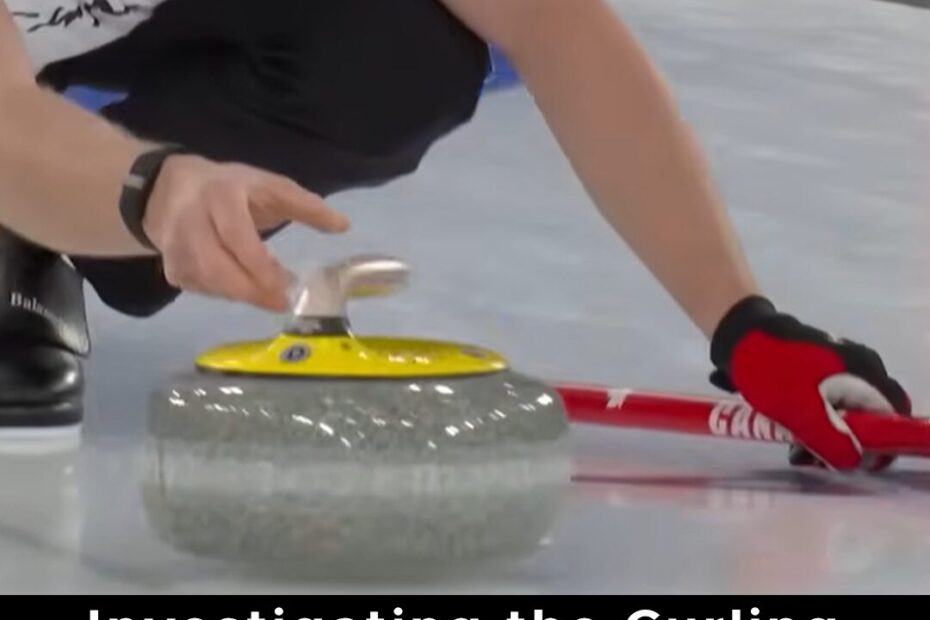
Australia may have secured a record medal haul at Milano Cortina 2026, but one of the biggest talking points from these games revolved around accusations of teams “double-touching” the curling stone after its initial release. Both the Canadian men’s and women’s team, and the British men’s team, were accused of the controversial practice during these Olympics.
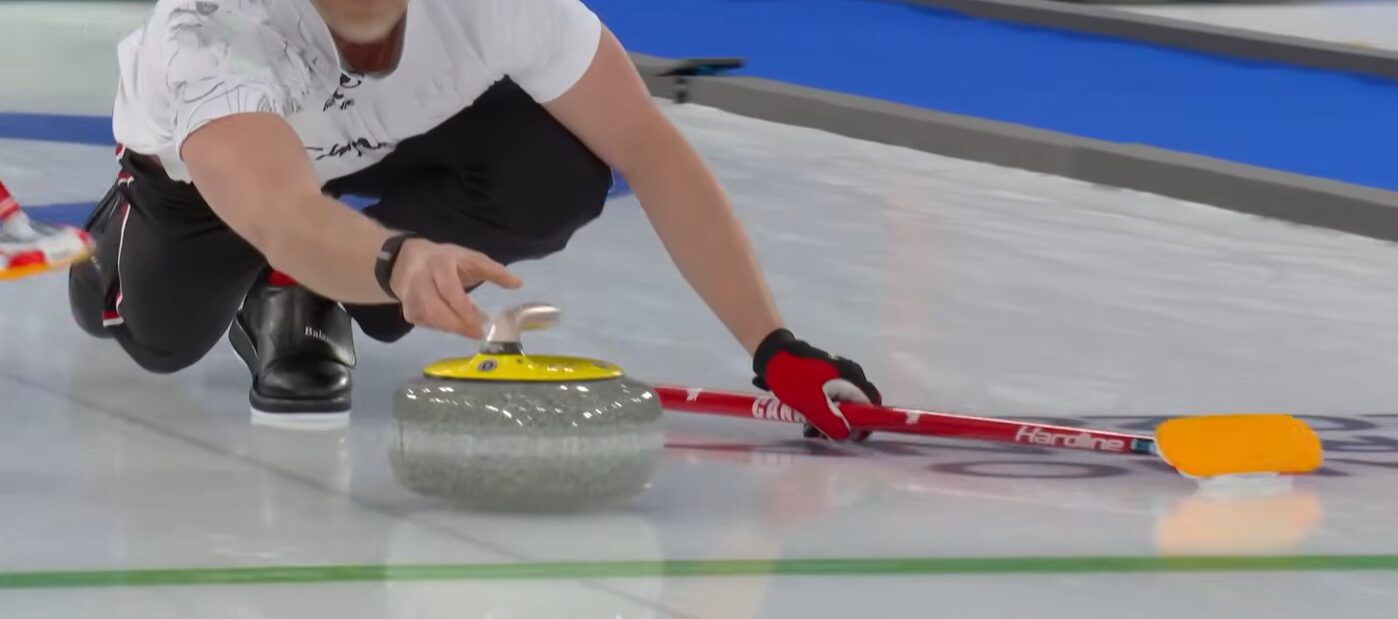
When an Olympic medal is up for grabs, you can understand that officials must take it seriously when teams are accused by opponents of making imperceptible contact with the curling stone after release, grazing the stone beyond the hog line. World Curling deploys on-ice umpires and relies on electronic handles to review each delivery and ultimately found no infractions, yet video clips circulating on social media continued to fuel the debate.
After the uproar, World Curling has since clarified that double-tapping is not allowed.
The rules state that when delivering a stone, players can retouch the handle as many times as they wish before the hog line, the point at which they must let go. Touching the handle after the hog line is a violation and will result in the stone being removed from play.
During forward motion, touching the granite of the stone is also not allowed and will result in it being removed from play. The rules state: “The curling stone must be delivered using the handle of the stone.”
This gap between official regulation and a growing social media outcry can be explained by noting that the sensors only register touches on the handle, not the granite stone itself.
What’s the big deal anyway? Let’s check out the difference that one deft touch can make with Ansys LS-DYNA!
To quantify how even the slightest touch might alter the outcome of a match, we conducted two Ansys LS-Dyna simulations: one representing a perfectly clean release and the other including a minimal post-release force.
We built a standard curling-stone model complete with handle and ice surface and set the initial velocity to 2 m/s (just over 7 km/h) and the angular velocity to 1 rad/s. Stone-ice and stone-stone frictional contacts were defined, and a fine mesh was used for the handle and body of the stone. Both runs were simulated for just over 7 seconds to capture the stone’s full trajectory and any resulting collisions.
In the first (baseline) run, no external forces were applied after release. In the second run, we introduced a 5 Newton lateral force on the stone over the first half-second, representing a light finger graze beyond the hog line. All other parameters, such as release speed, spin rate and ice friction, remained identical.
The baseline simulation showed the launched stone contacting 2 opposing stones and displacing them, yet it came to rest inside the second ring. Despite a strong performance, the stone failed to score and the end was lost. In the double-touch scenario, the brief five-newton force altered the stone’s trajectory. After colliding with opponent stones, the stone settled closest to the button, earned the point and secured the end. This dramatic swing in result highlights curling’s extreme sensitivity to minute forces: what appears to be an imperceptible graze can indeed decide a match!
Our Ansys LS-Dyna study confirms that even the most minimal unintended contact can deliver decisive effects on gameplay in a sport such as curling. While World Curling’s electronic handles are designed to register only deliberate pushes past the hog line, an undetected finger graze on the granite could be enough to swing a high-stakes competition. As the sport’s detection technology evolves, integrating higher-resolution sensors or automated video-referee systems may become essential to preserve fair play for all competitors.
At LEAP, our engineers specialise in the application of digital engineering and simulation to complex technical problems, so our role is simply to provide an objective assessment and (hopefully) offer clarity through scientific analysis of potential outcomes.
Find out more about the simulation tools we’ve used in today’s blog at https://www.leapaust.com.au/ls-dyna/