
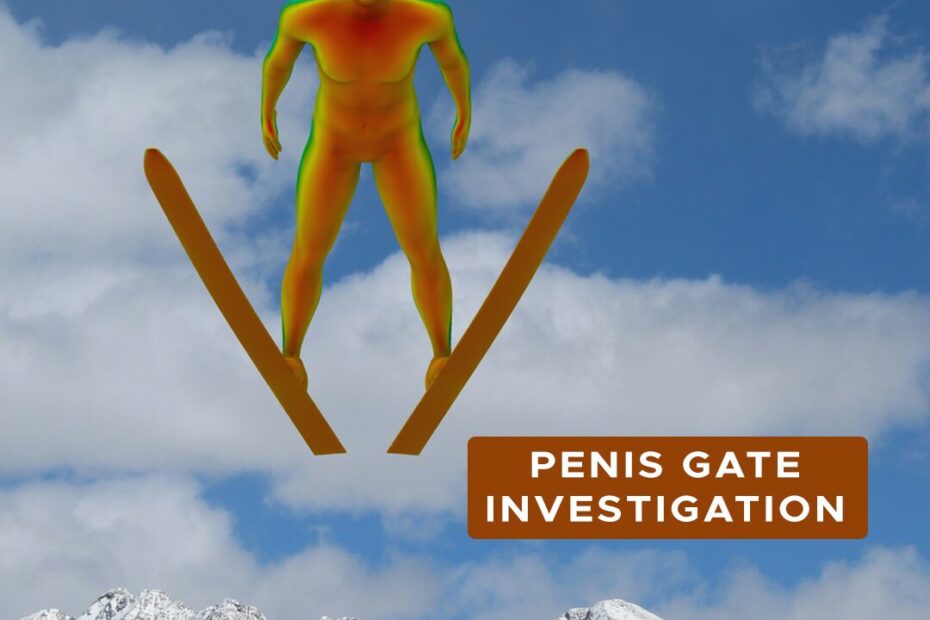
Milano Cortina 2026 was Australia’s most successful ever Winter Olympics, but in future when we look back at these games, what will we remember most?
It may be rare for experts in aerospace engineering and penoplasty to be consulted on the same topic, but leading authorities from both fields congregated to thrash out the biggest controversy of Milano Cortina 2026: Penis Gate. The foreplay started with rumours pre-Games that ski jumpers were deliberately injecting hyaluronic acid into their penises in an attempt to jump further: by manipulating their aerodynamics through an increase in the surface area of their otherwise skin-tight jumpsuit.
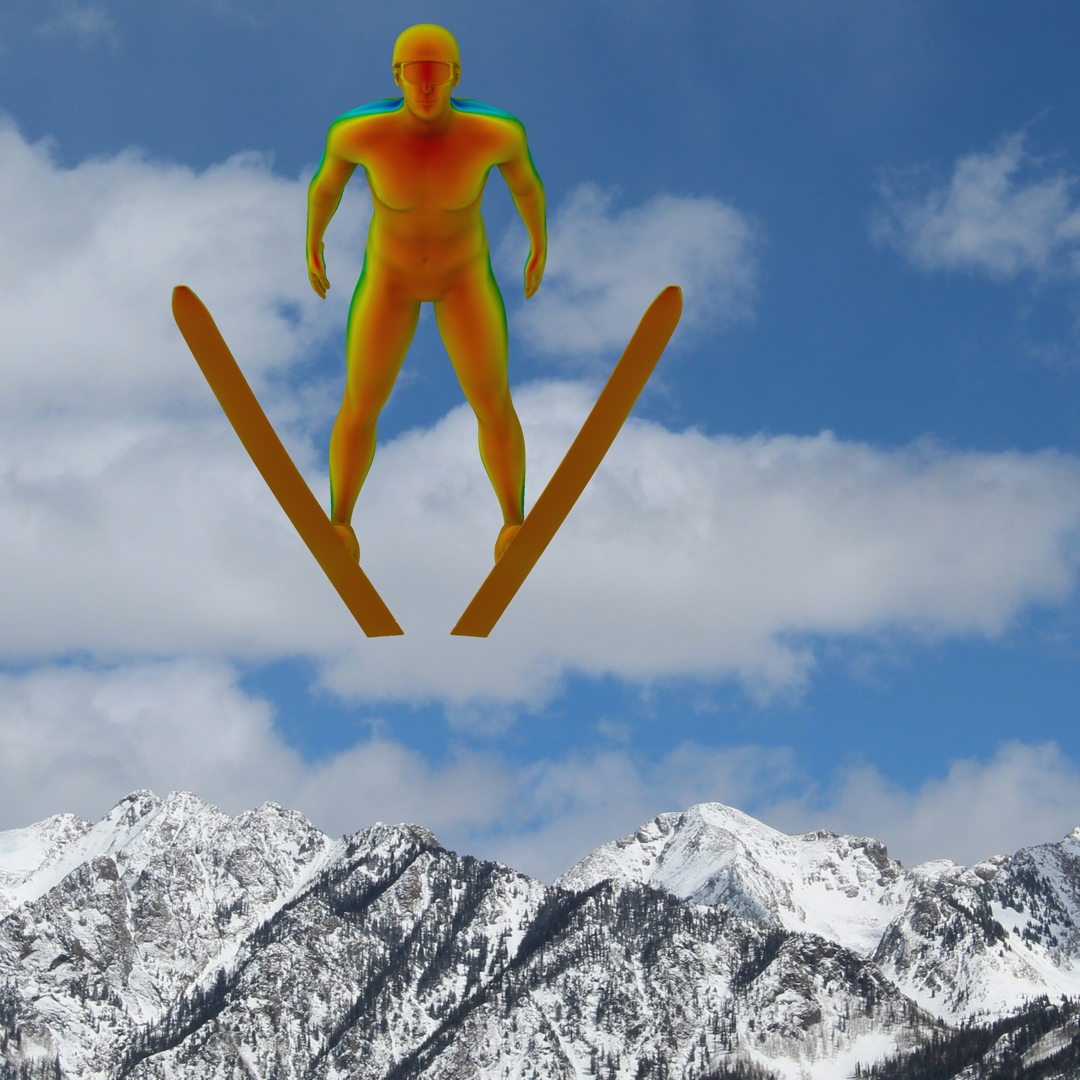
Ski jumping is indeed an Olympic sport where small margins are obsessed over, with athletes and team engineers scrutinising any variable that could extract an advantage down to the last millimetre, including boot angles, ski length and nose shape, fabric porosity and in-flight body position and posture.
Ski-jumpers are measured before each season with a 3D body scanner, with dimensions taken from the lowest part of the genital area, which is then used as the basis for their suit’s design. Previous controversies have involved the use of padding inside the suit, but the rules were changed to enforce use of a 3D scanner so that outside objects could not be inserted beneath the fabric.
The controversy lit up during the final week after an explosive revelation from a leading authority on penoplasty who admitted to having performed the procedure on an unnamed ski jumper. Italian plastic surgeon Alessandro Littara openly stated ”I treated him last month and used a generous dose of hyaluronic acid.” along with estimates that penis circumference could be increased by 10-20mm.
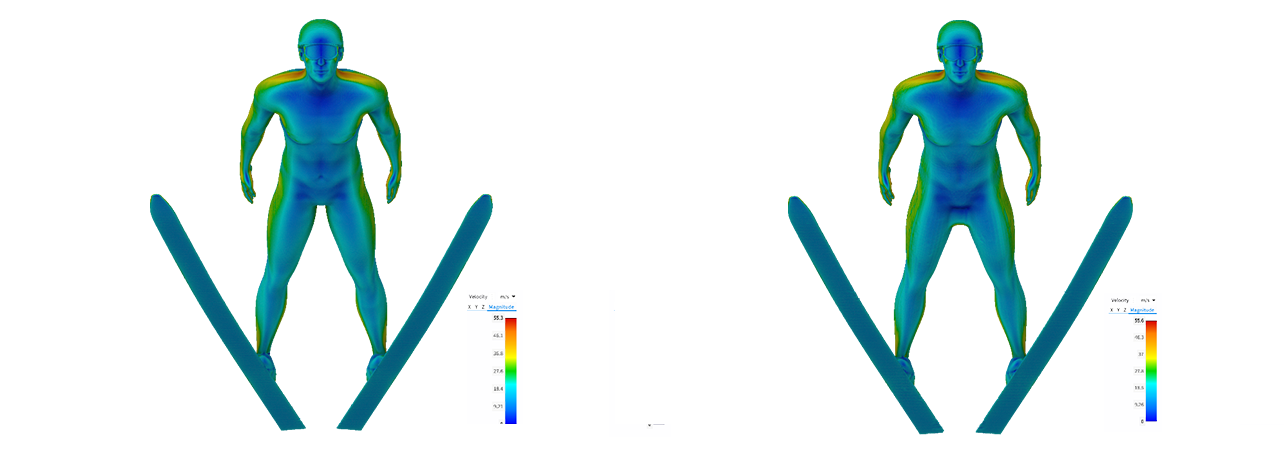
Baseline case and modified crotch with 8cm webbing with body contours showing local velocities
When a ski jumper flies after take-off, they spread the skis to create a V-shape and lean forward into an optimal aerodynamic position. However, there’s still a large open area between the skier’s legs – compared to someone wearing a wingsuit with webbing between the legs. Increasing the surface area is an attempt to increase lift force and achieve a longer flight over a greater distance.
In 2016, the governing body changed suit regulations, requiring a non-stretchable strap to be sewn inside a skier’s suit above the waistline, aimed at preventing the skier from stretching the suit below their crotch. Those old rules, of course, didn’t account for the temporary enlargement of the skier’s body parts at the time of the 3D laser scan.
So if a skier could bulge their crotch temporarily for their scan, they would have the advantage of a looser fitting suit in the crotch region, and voila: a bigger platform area during flight. In a sport where Olympic medals may be decided by just a few centimeters, any additional hang time could be the difference between gold and silver!
Lasse Ottesen, a former Olympic ski jumper and now race director for the Nordic Combined event at FIS, was quoted as saying “it has a huge impact”. He estimated that ski jumpers with just 10mm of extra material around the crotch could increase their jump length by as much as four meters.
Let’s check these extraordinary claims with Ansys Discovery 2026!
Why Ansys Discovery 2026 R1? Discovery Explore mode has a range of new features just released that helped produce these results accurately and in record time!
Firstly, we needed to manipulate the baseline scanned geometry of a ski jumper to add the webbing below their crotch. Sub-Division (SubD) Modelling was used within Discovery to convert this faceted geometry into a SubD body, which then allowed for each “pushing / pulling” and smoothing of the geometry. Within the SubD framework, the Bridge tool was used to create a webbed region between the legs, replicating the increased suit size. The SubD model was then surface-wrapped to generate a geometry ready for simulation within Discovery.
The seamless integration of geometry to simulation enables users to easily revert from the simulation environment back to the geometry for design modifications, streamlining the workflow and improving design iteration efficiency.
Discovery 2026 R1 includes additional features that give users greater control over the solver settings. Boundary layers were applied to provide near-wall refinement around the skier’s body and skis. Surface mesh controls were added to the skier’s body to ensure a sufficiently refined mesh capable of capturing the detailed shape of the geometry.
The coupled solver also allowed for more robust and accurate convergence to rapidly capture these aerodynamic effects. Discovery’s Explore mode was used to rapidly generate results by utilising GPU-based meshing and simulation. Transient results could also be obtained using the transient solver, allowing for the study of time-dependent aerodynamic effects.
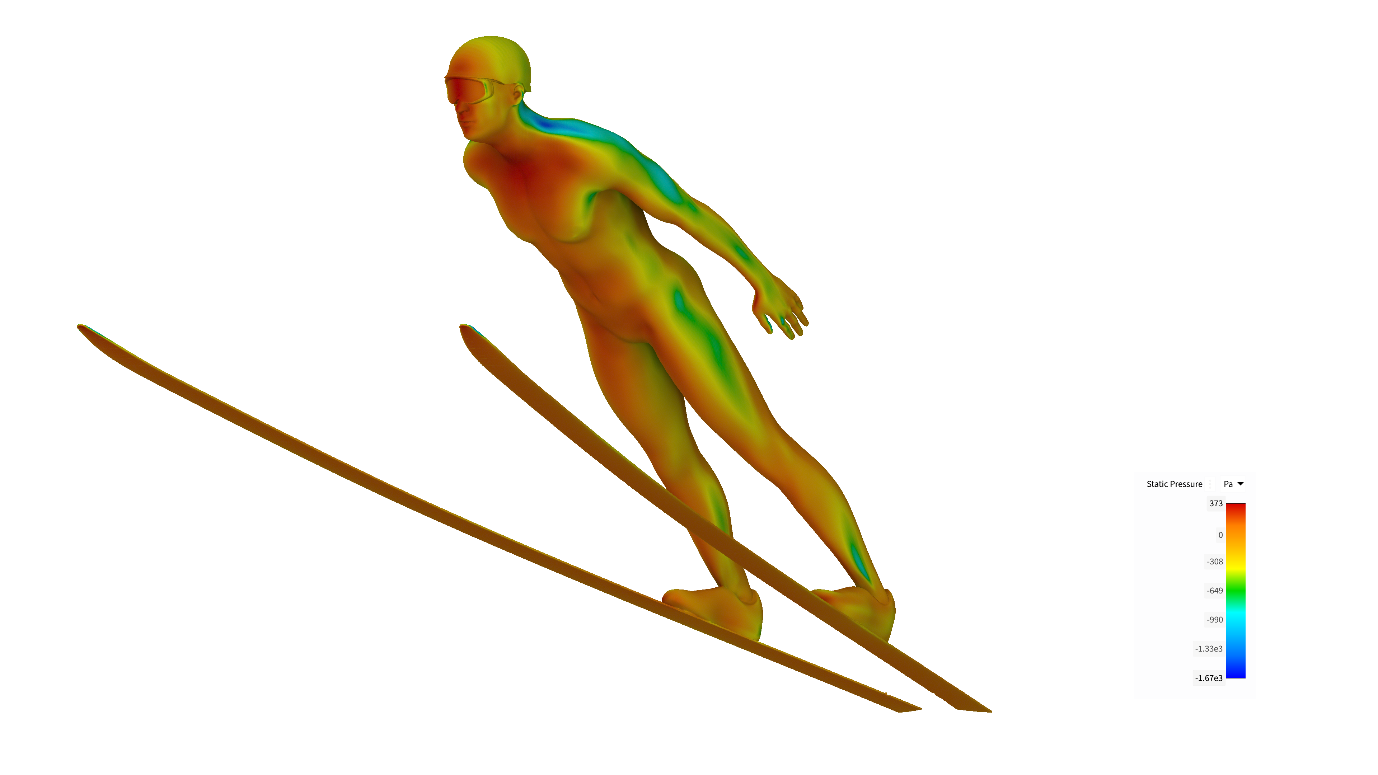
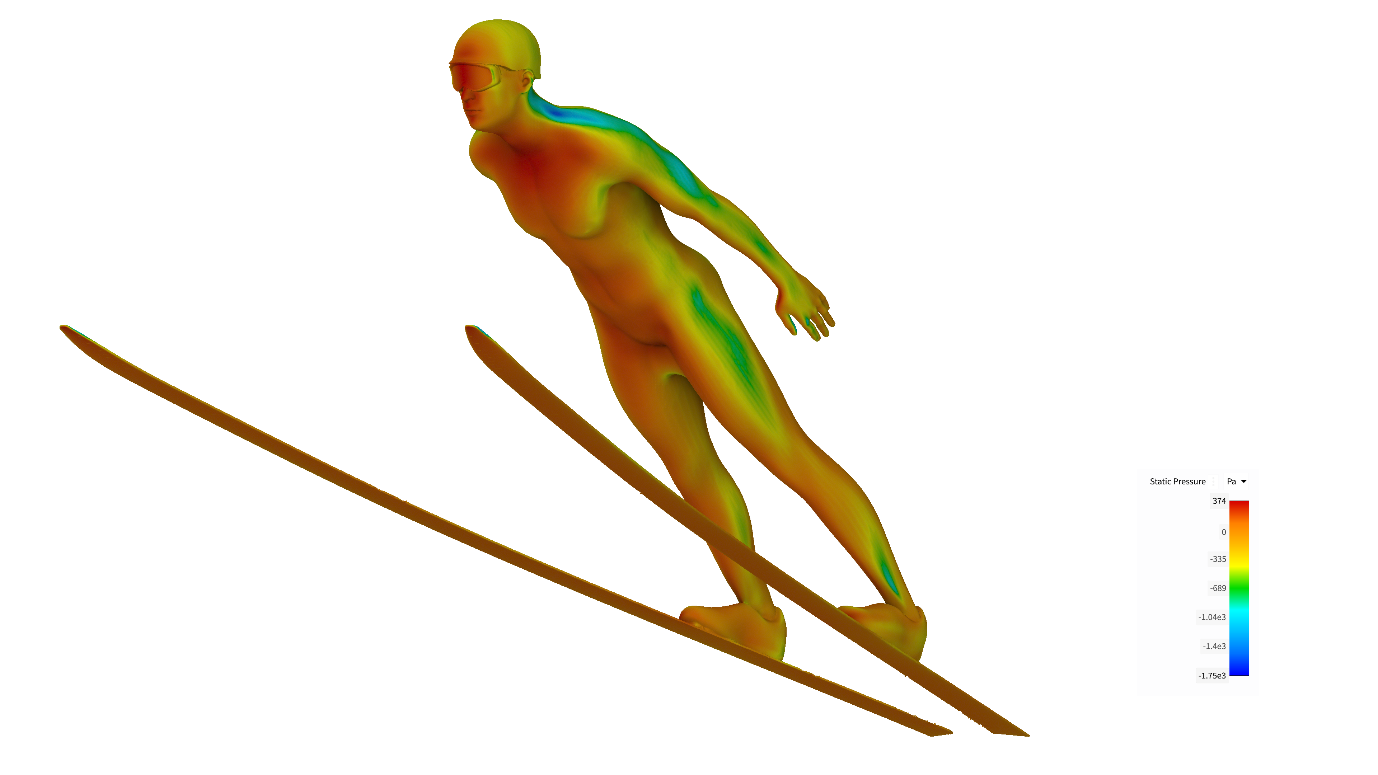
Baseline case and modified crotch with 8cm webbing with body contours showing static pressure
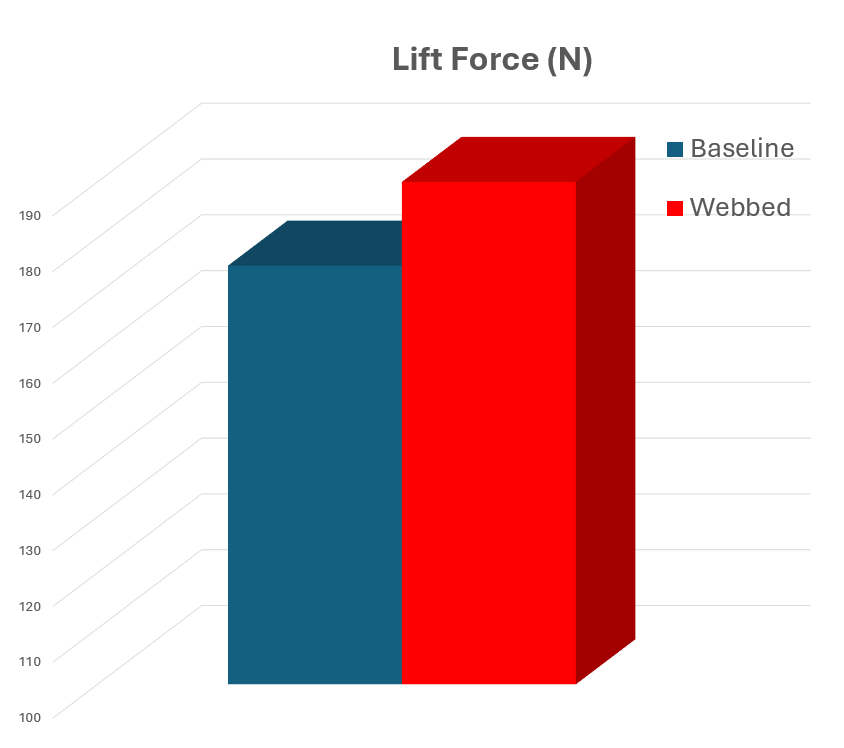
For an 8 cm increase in the webbing and a flight speed of 25 m/s, the total lift force increased from 175 N to 190 N. This equates to an 8.6% increase in lift force.
Penis Gate reflects how far athletes may go to gain marginal aerodynamic advantages in a sport decided by small margins. The scandal brings together a heady mix of questionable medical procedures, complex aerodynamics concepts, inadequate equipment regulations, medical/ethical concerns, and fuels the ongoing debate about what counts as “performance enhancement.”
We should note that investigations are ongoing, no athletes have been formally sanctioned and that WADA notes that injection of less than 100ml of hyaluronic acid isn’t currently listed as being banned. But the scandal has undeniably become the most talked‑about story of the 2026 Winter Olympics.
This is clearly an instance of the rules of a sport failing to keep up with the innovation and deviousness of those searching for even the most fractional edge. At LEAP, our engineers specialise in the application of digital engineering and simulation to complex technical problems, so our role is simply to provide an objective assessment and (hopefully) offer clarity through a scientific analysis of these previously unconfirmed claims!
Find out more about the simulation tools we’ve used in today’s blog at https://www.leapaust.com.au/ansys-discovery/